
If I’m a Match, I’m Doing It: Mitch Phillis’s Kidney Donation Story
The very beginning of this journey was about 10 years ago, when we found out that my dad’s kidney function was not as good as it should be. At the time, he said he felt fine and didn’t have any of the symptoms they said he should.
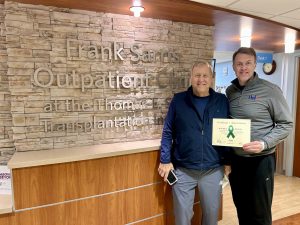
Year by year, his kidney function continued to decline. Two years ago, they said it was getting worse, although he still didn’t really feel any different. Then all of a sudden he was told he would probably need a kidney transplant.
By then, he was feeling it a little, but he never felt awful. Part of it was being an old tough guy, and part of it was thinking that he was getting older, so of course he was going to feel more sluggish.
In December 2025, they told him he needed to get on the transplant list and start looking for a living donor. A couple of my aunts and uncles signed up, but they were pretty much dismissed immediately. In January, my wife and I were tested. She was knocked off the list right away, but I passed that initial call.
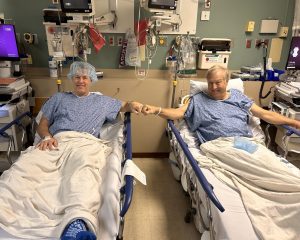
In February, I went to UPMC for more tests. For whatever reason, the whole time I just figured I would match with him, although I guess that is not always the case. I said, if I’m a match, I’m doing it. My dad told the doctor he was going to get a new kidney soon. The doctor told him he needed to start dialysis, but my dad kept telling everyone: No, I’m going to have a match soon, you’ll see.
On March 7, they called to tell me that I was 100% qualified to donate, and I was a match for my dad. I asked when their first open day for surgery was, and it was April 2, so we scheduled it right then. My dad got down to 15% GFR and was right on the edge a week or two before the surgery was scheduled.
I intentionally didn’t ask a lot of questions going into it because I was going to donate no matter what. It was my wife who asked the key questions, like what donating would mean for me, if it would affect my life expectancy, and what would happen if I needed a kidney in the future.
The whole process went pretty smoothly. I was up and walking the day of the surgery, but quite gingerly. I went home the next night. Getting into and out of bed was a bit of a weird feeling for a week to 10 days. The gas they put in you was the most uncomfortable thing for me.
In hindsight, it was not too bad. We walked some every day. By the seventh day I was walking at least a couple miles. After about 13 days, I wanted to see what it felt like to swing a golf club, so I went out and hit about 10 golf balls. It didn’t hurt, and I wasn’t sore the next day. I called my doctor to tell him what I did and he said DO NOT DO THAT.
I waited another week, then I hit 50 balls. A week later I started with my golf league. Four weeks later I played nine holes of golf, and I’ve played every week since then. It never really bothered me.
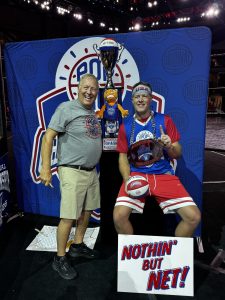
Around the same time, I noticed that they were doing qualifiers for the Pop-A-Shot National Championship. I had played a ton of Pop-A-Shot in my basement as a kid, and I took it to college and was always the best one at it. Now that I had made it through surgery, I thought it would be something fun to try.
Somehow, I played well enough, and just four months after my donation, on August 7, I won the Pop-A-Shot National Championship live on ESPN, with my dad right there in the audience cheering me on.
About the Author
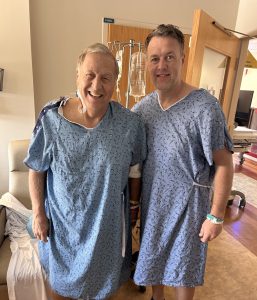
Mitch grew up in small-town Salem, Ohio, on his family’s farm, where the work was never done and there was always something you could be doing. Although he didn’t always enjoy the work, the strong work ethic and examples set by both sides of his family inevitably rubbed off on him. Mitch knows he’s very lucky to have such great friends and family, and also credits the many great coaches he’s had.
From a young age, he was extremely competitive, a trait that continued to grow through his involvement in athletics. He played football and basketball at United Local, and then football at Mercyhurst College. He knew other guys were more athletic than him, but that if he worked harder and applied some extra sports IQ and strategy, he could compete with anybody.
Mitch now lives in North Canton, OH with his amazing wife, Susan, who was his caregiver after his kidney donation. They enjoy walking their two dogs together almost every day, which was a key part of his initial rehab.