
I Didn’t Think I Was a Viable Candidate: Billy Duke’s Kidney Donation Story
When my lifelong best friend shared on social media that his son needed a kidney transplant, he asked everyone to spread the word and consider becoming a living donor. In my 60s and with some past health issues, I assumed I would not be a viable candidate.
Whenever I saw my friend, I would ask how his son was doing and how the search for a kidney was going. I knew that family members had been tested but were either unable to donate for health reasons or were not a good match. Other opportunities to receive a kidney from deceased donors had ended in disappointment.
This began to weigh on me. Then, early one Monday morning, another social media post appeared on my phone with a new appeal to friends to consider stepping forward. Two thoughts hit me at that moment: (1) “Somebody needs to do this,” followed by (2) “Maybe that somebody is me.”
I did some research and learned that it is quite common for people in their 60s, 70s, and even 80s to become living donors. So, I called Emory Transplant Center to get more information and find out how the process worked. They asked me several health questions (none of them age-related) and explained the steps involved. They sent me a lab order for initial bloodwork, which confirmed that my blood type was a match.
The next step was to spend a full day at Emory for evaluation and a battery of tests. My transplant coordinator put it another way: It would probably be the most comprehensive physical examination of my life. He explained that for any kidney donor candidate, whether they are 28 or 88, good health is a prerequisite. Not only is the donor being tested for compatibility with the recipient, but also to ensure that their own health meets a threshold that would not put them at undue risk.
I understood that any surgery involves risk. But I learned that according to data gathered over thousands of transplants, there has been no correlation between a donor’s age and the degree of surgery risk, relative life expectancy, or subsequent quality of life.
Billy Duke
The evaluation was also an opportunity for me to ask questions. I understood that any surgery involves risk. But I learned that according to data gathered over thousands of transplants, there has been no correlation between a donor’s age and the degree of surgery risk, relative life expectancy, or subsequent quality of life.
Some of my test results dictated that I go back to Emory for some follow-up testing. Those results were good, and it was confirmed that I was a match. My wife and I then had a wonderful video conference with Emory’s chief nephrologist. He answered all our remaining questions and made us both feel at ease. At the end of the conference, I told my wife that I wanted to do this.
I talked separately with my two adult children about my decision. When I told my son, it took a minute to digest it, but then he said, “That’s great! Let’s make sure we play some golf before the surgery!” But I struggled with telling my daughter. She was pregnant for the first time, and I didn’t want her to be worried about me when she had plenty to tend to of her own.
From early on, I had been talking regularly with a donor mentor through the National Kidney Registry. Having been a donor herself, she was a tremendous help. At this point, I asked her if she could connect me with a male cohort who was closer to my age and who might have faced a similar conundrum. She made that connection, and the gentleman I spoke with told me how his daughters went from strong resistance to becoming huge advocates. That was exactly what I needed before talking with my daughter. When I met with her and my son-in-law, after a few minutes they were both nodding and smiling.
With my decision cemented and my family on board with it, I was totally at peace. I called my best friend and told him that I was going to donate a kidney to his son. It felt so amazing to say those words to him. I cannot even imagine how he must have felt.
The surgery was on December 4, 2025. At 6:00 a.m. that morning, both families sat in the same waiting room. We chatted for a few minutes, hugs were exchanged all around, and then the nurse called me in. Six hours later I woke up in recovery.
I had been advised to get on my feet as soon as possible. So that night, I got out of bed and asked an attendant to walk down the hall with me to the recipient’s room. That visit was followed by two more before my discharge.
With surgery and recovery occurring during the Christmas season, a time we celebrate God’s greatest gift to humanity, my gratitude list was long. I was especially thankful for my health and for the opportunity I had been given to help someone else have a better life.
The recipient’s recovery was more difficult than mine. His dad kept me updated with texts and phone calls, but it was a stressful time. A week before Christmas, his numbers began to improve. It is hard to describe how much this lifted my spirits. I am so happy that he continues to get stronger and is now enjoying everyday activities with his beautiful family.
As for my own recovery, I had to take it easy for a couple of weeks, but I began walking slowly for short distances as soon as I got home. By mid-January I was walking two miles a day.
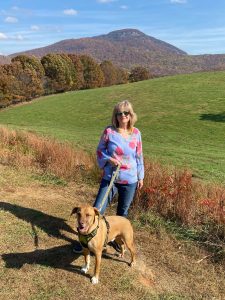
Today, my wife and I are looking forward to hiking with our dog to the top of the same North Georgia mountain that we hiked last November. I resumed playing golf after two months. In April, the recipient, his dad and I attended the Masters together. Next up, we plan to get together for 18 holes this summer.
Donating a kidney is perhaps the most meaningful thing I have ever done. Not a day goes by that I don’t think about it. If you have ever thought about donating, or if such an opportunity ever arises, I encourage you to consider giving the gift of life. There is nothing quite like it.
About the Author
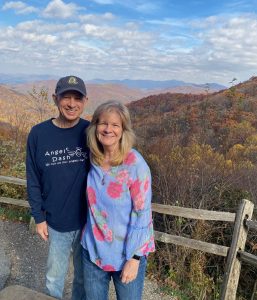
Billy Duke lives just outside his childhood hometown of Jackson, Georgia. Along with his wife of almost 40 years, Jeanene, they have two adult children, and they recently became first-time grandparents. During his 45-year career, Billy worked in information technology, primarily with Delta Air Lines, and financial services. He founded and ran his own financial advisory firm for several years prior to his retirement in 2026.
His retirement plans include spending time with family and friends, playing more golf, cheering on the Atlanta Braves, and hiking with Jeanene and their black mouth cur rescue dog, Rhett Butler.
Becoming a living kidney donor in December 2025 has been a life-changing experience for Billy. He hopes his story will help inspire and encourage others to consider becoming a living donor.