
“Anyone Who Saves One Life Is as if He Saved an Entire World”: Eliyahu Wincelberg’s Kidney Donation Story
About nine years ago, my friend and neighbor contracted a rare disease and needed a bone marrow transplant. Unfortunately, there was no suitable match for him in the bone marrow registry, so registration drives were arranged around the world through Gift of Life. Ultimately, well over 16,000 people were swabbed and added to the registry in the hope of saving his life. Together with several friends, I organized a drive in a local synagogue, and over 400 people were swabbed.
I was swabbed as part of that drive as well, and I ended up matching with a 59-year-old patient who had myelodysplastic syndrome, commonly known as MDS. I was among the happiest people in the world. Donating bone marrow is generally incredibly simple. In most cases, you sit in a chair for a few hours while a machine filters your blood. You are back home that night, back at work the next day, and you have saved someone’s life.
Then, one day, Gift of Life called to tell me that the hospital had canceled the transplant, and they had not been given an explanation why. Maybe the patient had not made it. Maybe he was too sick to remain a candidate for transplant. Maybe he had found a relative who was a perfect match. Maybe he had decided to live with the disease instead of treating it. Who knows?
I was devastated that I had missed out on this golden opportunity to save someone’s life. My wife commented that there was always organ donation. I discussed it with her, and we both agreed that I would do it for someone I knew, but we could not really imagine giving an organ to a stranger.
Several years later, another teacher at the school where I teach needed a liver donation. I applied to be a liver donor, but before I got too far into the process, he received a liver from a deceased donor.
Fast forward a couple of years, and I was still upset that I had missed out on those two opportunities. On September 11, 2023, I was back in the same synagogue where I had helped run the bone marrow drive years earlier, and there was a kidney donor registration drive taking place. I WhatsApped my wife and asked if she was OK with my signing up to be a living kidney donor. I did not really expect her to say yes, but she gave me the second-best “yes” she ever gave me.
On February 17, 2025, I was told that I was a match for a child who needed a kidney. I knew next to nothing about the child, but I knew that this was the perfect opportunity. It was everything I had wanted. Very few people are lucky enough to donate to a child. When I had first been swabbed, I had hoped to match with someone young, and now, sure enough, I had.
The first step in the process was the crossmatch test, which I have heard described as a “kidney transplant in a bottle.” Basically, they take blood from the donor and blood from the recipient and check whether the two react with each other. About a month and a half later, the hospital reached out to tell me that there was a low level of reactivity between us, and they were going to try to find a better donor.
I was crushed. I had tried to donate bone marrow and failed. I had tried to donate a portion of my liver and failed. Now I had tried to donate my kidney, and that seemed to have failed too.
Then, out of the blue, I was contacted in August and told that not only was I a match, I was actually the best possible match: a six-out-of-six HLA match. The top immunologists in the country had reviewed the information and determined that the minor reaction they had observed was actually something else that had nothing to do with me. It would take me months to get an answer as to what had changed, but that is probably not something I should share on a public forum.
They had actually known for a while that I was a match, but they had not informed me because standard policy is that they only review one candidate at a time. They told me only after the previous candidate had been rejected.
I went in for my full day of testing the Thursday before Rosh Hashanah. The people at the Hospital of the University of Pennsylvania were wonderful. They were caring and professional, and they gave me all the time in the world to answer all my questions, explain everything, and test for anything and everything in order to be as certain as humanly possible that I would suffer no long-term harm by donating.
One thing that struck me as I went through all the tests was that I was probably the only person in the hospital going through these tests without worrying that something was wrong with me. This was especially obvious as I sat in the waiting room for my CT scan. I could easily see that many of the other people waiting had serious medical issues, and several were openly discussing their conditions with one another. The whole process helped me appreciate the incredible gift God had given me of excellent health. It also further solidified my desire to give that same gift to this young child, if I were lucky enough to have the opportunity.
The whole process helped me appreciate the incredible gift God had given me of excellent health. It also further solidified my desire to give that same gift to this young child, if I were lucky enough to have the opportunity.
Eliyahu Wincelberg
At the time, I was not being public about my desire to donate, but I did tell my immediate family, largely because I needed to know whether there were any family medical conditions that might affect my ability to donate. There was one genetic issue to look out for, but I was tested at my local hospital and was cleared.
That testing took place in the oncology and hematology department, and once again I could easily see how unwell some of the other people in the waiting room were while there I was, blessed to be in such good health that I could afford to give away a kidney with no real risk to my well-being.
That Rosh Hashanah was perhaps the most meaningful Rosh Hashanah I had ever experienced. I had so much more to thank God for and so much more to pray for than ever before. As the rabbi of my congregation, I dropped my first subtle hints that kidney donation was on my radar by sharing a story about kidney donation in a sermon about charity on the second day of Rosh Hashanah.
In November, I was formally approved to donate my kidney. I figured I would probably donate shortly after Hannukah, so I began freeing up my schedule for that time. I have many jobs. In addition to being a father of five and the rabbi of an Orthodox Jewish congregation, I manage a program that trains Orthodox rabbis, I teach middle school science, and I am a magician. But as the famous Jewish dictum goes (Sanhedrin 4:5), “Anyone who saves one life is as if he saved an entire world.” There was nothing more important to me than saving this child’s life.
The hospital made it very clear that they would gladly work around my schedule, but I could not imagine making the boy continue dialysis longer than necessary just because I had made plans, so I avoided committing to anything more than a month out.
As the process dragged on, it became very difficult not to be able to make plans. I lost out on numerous performances, for example. But I recognized how lucky I was to be on the giving side. People on the transplant list waiting for a kidney need to be ready to drop everything at a moment’s notice if a kidney suddenly becomes available.
I really wanted answers about why everything was taking so long, but because of HIPAA regulations, they were only allowed to give me vague hints. They did keep assuring me that everything was looking good; they just needed more testing.
Finally, they gave me a date: April 15. I found it funny that it would be on Tax Day, a day when people all over America feel like they are losing an arm and a leg, while I would be losing a kidney. That date ended up being delayed due to medical issues on the recipient’s side, and the surgery was rescheduled for May 1.
That date was even more meaningful, because it coincided with the minor Jewish holiday known as Pesach Sheini, the “Second Passover,” a day set aside as a second chance for those who had been unable to celebrate Passover properly. It felt deeply meaningful to give my kidney on a day of second chances. I had a second chance to donate an organ after so many disappointments, failures, and delays, and my recipient was getting a second chance at life.
Some people choose to keep their decision to donate a kidney private. When I began this process, I did not think I knew any kidney donors, but it turned out that my wife’s uncle had donated and had simply chosen to keep it private. I did not even find out that he had donated until just a few weeks before my own donation.
A person can only donate one kidney as a living donor and save one life directly, but if he can inspire others to do the same, he can have a share in many more lives being saved.
Eliyahu Wincelberg
I asked around and was told that it would be far better if I were public about my donation. It is important for people to hear about living kidney donation and to begin thinking of it as something normal that people do. The more people see people they know going through kidney donation and having a positive experience, the more likely they are to consider it themselves. A person can only donate one kidney as a living donor and save one life directly, but if he can inspire others to do the same, he can have a share in many more lives being saved.
Over the two weeks before my donation, I had a personal conversation with each member of my rabbinic training program. The Saturday before my donation, I told my congregation about my plans in my Sabbath morning sermon. Everyone was incredibly supportive. Not a single person tried to talk me out of it or even expressed opposition to the idea. My wife received an incredible number of offers for help and support in every way imaginable.
I had planned to tell my students about the donation the day before surgery. I had prepared a two-day lesson about the kidneys that would end with teaching about kidney donation. I planned to end class by giving them cake and telling them that they would not be having me for the next few weeks because I would be donating a kidney.
However, two days before the surgery, my wife came down with strep, and I was terrified that I would catch it and the surgery would be delayed yet again. I spent the next two days wearing an N95 mask around my family and I went to a local clinic to get tested for strep both nights. Thank God, I did not catch it.
Since I could not guarantee that the surgery would not be delayed, I was not interested in telling my class that I would be out donating my kidney, only to be right back teaching them on Monday. Instead, I told my students that a relative of mine would be donating, which was true, as the Talmud teaches in Sanhedrin 9b that a person is considered related to himself. I gave them cake to celebrate and had them all write letters to “my relative” and to the recipient. Their letters were incredibly sweet. The morning of the surgery, I gave the go-between the letters to give to the recipient and his family.
The night before the surgery, I barely slept. It was not because I was nervous. It was because I had to be up at 2:45 AM to make it to Philadelphia in time, and I still had a lot to do, including writing my own letters to my recipient and his family. I figured there was not much point in sleeping that night, since I would be sleeping plenty after the surgery anyway.
On the morning of the surgery, just before shutting off my phone, once it was clear that I was really about to donate and there would be no more delays, I posted on my WhatsApp status and in several local groups that I would be donating. Once again, every single person was incredibly supportive, although I did not see their messages until afterward.
Since the surgery was on a Friday, my wife was unable to join me in the hospital, as she needed to be home taking care of the kids over the Sabbath. My brother graciously agreed to fly in from California to stay with me while I was in the hospital, and we had a wonderful time together. Most of my hospital stay was over the Sabbath, so I could not use electricity, but we spent a lot of quality time together talking, walking, and playing card games.
It was very important to my wife and me that our children not see this as something scary that I was doing, but rather as an exciting opportunity we had been given. The day before the surgery, we had our children color pictures and write letters to the recipient, which I gave to the go-between to pass along to his family. We also bought our kids scooters and stuffed kidneys as gifts, and we ordered many of their favorite foods for suppers and desserts while I was recovering.
During this long process—15 months from the time I matched my recipient until the time I donated to him—I had a lot of time to research kidney donation. I read numerous books and articles, watched and listened to many interviews and podcasts, and spoke with a number of people who had donated. I thought I knew exactly what to expect. But partly because of the professionalism and expertise of the incredible team at the Hospital of the University of Pennsylvania, and partly because of the prayers of all the people who prayed for me, my recovery was far easier than anything I had heard from anyone. I never needed opioids, and I was off painkillers a week after surgery.
As soon as I came to my senses after surgery, the first thing I did was ask the nurses whether I could go for a walk. I was as shocked as the nurses that I felt up for it, but I did, so I walked. As I walked through the halls that day and the next, I reflected on how I was quite likely the most blessed person in the hospital, at least outside of the maternity ward. I felt so lucky to have the opportunity to save a young boy’s life.
I spent a lot of time looking out the window at the end of the hallway toward CHOP, the Children’s Hospital of Philadelphia, where my recipient was, wondering how he was doing. Most donors who donate to people they do not know, commonly called altruistic donors, constantly ask how their recipient is doing and are basically told that because of HIPAA regulations, they cannot be told anything unless the other side approves it. I resolved not to ask. If anything was approved to be shared, I was sure I would be told, and I did not want to be another donor driving them crazy about the fact that they could not share information.
By the next morning, 24 hours after surgery, the nurses told me that I was doing well enough to be discharged. Since it was the Sabbath, they said I could stay until the Sabbath ended and be discharged either Saturday night or Sunday morning. I chose to leave the hospital on Saturday night and stayed locally at the Clyde Barker Transplant House, which was wonderful. The next morning, a kidney donor I barely knew—we had spoken for about two minutes once a few weeks earlier—graciously drove from my hometown of Monsey to Philadelphia just to give me a ride home.
The following morning, I received a call telling me that the recipient’s grandparents and maternal aunts and uncles were in my hometown anyway for a brit milah and had asked whether I might possibly be up for visitors. They assumed I probably would not be, since this was only three days after surgery, but they figured it was worth asking.
I was shocked. I had been told not to expect contact for months, and here we were just three days later, with the opportunity to meet the family. Of course I said yes. I wanted to meet them and find out how my recipient was doing more than anything in the world.
Eliyahu Wincelberg
I was shocked. I had been told not to expect contact for months, and here we were just three days later, with the opportunity to meet the family. Of course I said yes. I wanted to meet them and find out how my recipient was doing more than anything in the world.
When they arrived, they were stunned by how well I was doing. They expected to see me lying in bed, but there I was, walking around as if nothing had happened.
That meeting was one of the highlights of my life. The family was unbelievably appreciative and thankful, and I was so thrilled to have had the opportunity to help them.
I had a dream about how I would introduce myself to the boy when the time came. I regularly perform free shows for sick children and their families, so I imagined coming as a magician to do a show without the boy knowing that I was the donor. At the end of the show, I would tell him that I was going to make his donor appear. I would make a big magical gesture, and nothing would happen. Then everyone would notice that my shirt had changed into a shirt that said “kidney donor.” It would have been phenomenal.
However, the family gave me the opportunity to speak to the boy over video call, and I could not turn that down, so there went that plan.
I also got contact information from several family members and began receiving regular updates about how the recipient was doing. While he obviously had a more difficult surgery than I had, and the hospital was being very cautious because of his complicated medical history, everything was going phenomenally well. He was recovering as well as they could possibly have hoped.
When it was time for me to go back for my post-op appointment, the boy was still in the hospital, so I arranged to visit him afterward. I also contacted an organization for sick children that I regularly perform for to see if they had anyone else in CHOP for me to visit. I had done this as well when I was across the street in the Hospital of the University of Pennsylvania for my full day of testing and again for my pre-op appointment, and both times I performed for a few children. It was very meaningful.
This time, they had three children for me to perform for, and one of them was actually my recipient, whom I was planning to visit anyway. I found that very funny.
I told the team at the Hospital of the University of Pennsylvania about my plans to meet the boy after post-op, and they were very moved by it. They did not have care packages meant for children, but they did their best to put something together on the spot that I could give him.
Meeting the boy and his mother in person was very special. I became emotional and immediately started crying, but then I realized that this was not the time or place for that. There was a seven-year-old boy in front of me who had never met me before. He doesn’t want to meet his donor as someone crying and emotional. I pulled myself together as best as I could and performed magic for him. He loved it, and it was a much better way for him to get to know me.
I was told afterward that he is normally very shy around strangers, which is completely understandable, and the family had been nervous that he might not say anything to me. However, the magic broke the ice completely. It was wonderful, and he now had a cool story about meeting his donor that he excitedly shared with friends and relatives.
Hopefully, one day in the near future, our families will be able to meet. We live only about a two-hour drive apart. While we come from quite different backgrounds, I am hopeful that my boys will become friends with him. He is right between them in age.
Donating a kidney as a living donor has been one of the highlights of my life. I feel, as so many other donors have said, that it is a shame we can only do this once. If a kidney grew back and we could do it again multiple times, I think pretty much all of us would gladly do it.
To paraphrase Nathan Hale: I regret that I have but one kidney to give.
About the Author
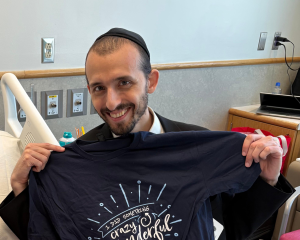
Rabbi Eliyahu Wincelberg is a dedicated communal leader, educator, and professional entertainer based in Monsey, New York, where he resides with his wife and their five children. For over 13 years, Rabbi Wincelberg has focused his career on spiritual leadership, advanced education, and community service. He serves as the spiritual leader of Congregation Ohaiv Yisroel of Blueberry Hill, a large and diverse Orthodox synagogue. In this role, he provides guidance to a vibrant community and frequently delivers lectures and seminars on a wide range of topics, including traditional law, biblical commentary, Jewish philosophy, and Talmudic texts.
In addition to his congregational duties, he directs an advanced rabbinic training program at Yeshivas Ohr Reuven, playing a central role in preparing future leaders for practical community service and spiritual guidance. Under his direction, the program has published an annual volume of scholarship for 11 consecutive years, and he recently authored and published his own book—a collection of contemporary commentaries and weekly insights on Biblical texts. His rabbinic ordination was granted by Yeshivas Ohr Reuven and the Talmudic University of Florida.
A committed lifelong scholar, Rabbi Wincelberg holds a bachelor’s degree in Talmudic law and a master’s degree in religious education from the Talmudic University of Florida, as well as a master’s degree in Jewish studies with a focus on education from Touro Graduate School. This deep educational background fuels his work in the classroom, where he serves as a middle school science teacher. He has a diverse teaching background, having previously taught upper-level physics as well as traditional law and practice (halacha), and he frequently serves as a reviewer and editor for academic religious publications.
Bringing a unique dimension to his work as a communicator, Rabbi Wincelberg is also an accomplished professional magician and mentalist. He performs high-impact close-up magic and captivating stage shows for both adult corporate events and family audiences. Rather than keeping this talent separate from his primary callings, he frequently uses magic as a creative educational tool to capture attention and illustrate complex concepts. Above all, he channels this skill into charitable work, regularly performing stage and close-up shows to bring joy, laughter, and a sense of wonder to seriously ill children and their families.