
I Had an Opportunity to Turn Something Deeply Painful into Something Meaningful: Fallon Scott’s Nutcracker Donation Story
I was diagnosed with Nutcracker Syndrome in August 2025, based on a scan that was performed in 2022. This diagnosis provided a long-overdue explanation for chronic back, abdominal, and pelvic pain that had persisted since childhood.
Like many patients with complex or rare conditions, I spent years navigating a fragmented healthcare system in search of answers. I underwent multiple surgeries, including the removal of my gallbladder, appendix, and, eventually, a hysterectomy. Each one represented as a step toward relief, a chance to finally feel normal. Each time, I hoped it would be the last procedure I would need. And each time, the pain remained.
Nutcracker Syndrome is a rare condition in which the left renal vein, responsible for carrying blood away from the kidney, becomes compressed between surrounding arteries. This compression disrupts normal blood flow and can lead to a wide range of often debilitating symptoms.
As I conducted my own research and connected with others living with the condition, I discovered that a therapeutic nephrectomy was a potential treatment. I did not hesitate.
Fallon Scott
I consulted with multiple specialists, each offering a different approach to treating Nutcracker Syndrome. Many of the proposed options relied on long-term medication management rather than addressing the underlying cause. As I conducted my own research and connected with others living with the condition, I discovered that a therapeutic nephrectomy was a potential treatment. I did not hesitate.
For as long as I can remember, I have been driven by a desire to help others. I signed up to be an organ donor when I first got my driver’s license and have always intended to donate my body to science. I also spent time working in blood banking, where I saw firsthand how a single donation could save a life. Faced with this decision, I realized I had an opportunity to turn something deeply painful into something meaningful. What had been a source of suffering could also become a source of impact.
That’s where, on my daily doom scroll through TikTok, I met Chandler, or @ChandlerTheKidneyGuy. Chandler started sharing his story of kidney disease on TikTok in the hope of finding a living donor. Family members and friends were tested but were unable to pass the donor screening. He was on both a physical and psychological rollercoaster.
Most of his videos were about his daily peritoneal dialysis routine and how he managed it as a college student. I saw myself in Chandler. While growing up, I had to navigate the education system with disabilities. I had to withdraw from college due to a brain tumor. I knew from my experiences how difficult school and regular life were with chronic illness. I hoped that by having a kidney transplant, he could experience those years that were lost to me.
I knew from my experiences how difficult school and regular life were with chronic illness. I hoped that by having a kidney transplant, he could experience those years that were lost to me.
Fallon Scott
I was ready to move forward with the donation, but the logistics were far from simple. Donating a kidney with Nutcracker Syndrome is complex, and only a small number of surgeons and hospitals in the United States are willing to perform the procedure.
I was thankfully able to schedule an appointment with Dr. Kenneth Chavin, who is one of the few doctors in the United States who has expertise in and provided care to Nutcracker patients. I first did video visits with him and then flew to Philadelphia to do my pretesting to make sure it was safe for my kidney to be removed.
I received final clearance to move forward with the therapeutic nephrectomy. I reached out to Chandler and told him the good news: we were getting him a kidney. Unfortunately, we were not direct blood matches.
Thankfully, the National Kidney Registry, an organization that facilitates living donations, has a program called the Standard Voucher Program. I was able to donate my kidney to someone on the waitlist for a kidney. Chandler then got a voucher to use when a more appropriate match was found for him.
I donated my left kidney on December 10, 2025. Chandler received his new kidney on February 17, 2026. Both surgeries were life-changing for us.
On March 26, 2026, we met in person. Chandler is thriving. That’s the part that’s hard to fully explain. One decision, one surgery, can completely change the direction of someone’s life. We share not just a bond shaped by sacrifice and pain, but now also grounded in joy, hope, and a willingness to share our stories. For me, it turned years of pain into something that finally made a difference.
There is still a waitlist of over 90,000 people waiting for a kidney. If you’ve ever thought about becoming an organ donor, I hope you’ll consider it. It’s one of the few opportunities where you can directly save someone’s life.
About the Author
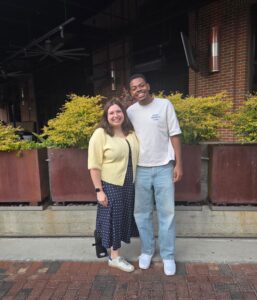
Fallon Scott is a living kidney donor and leadership facilitator from Charlotte, North Carolina. Diagnosed with over 30 medical conditions, including Nutcracker Syndrome, her work is shaped by both professional experience and lived expertise navigating complex healthcare systems. Her work centers on leadership development and social change, with a focus on helping individuals and communities navigate complex systems and expand access to opportunity. She now works alongside her kidney recipient to raise awareness about living donation and the realities patients and donors face, using storytelling and advocacy to help drive change. Fallon holds a BA in Public Health from the University of North Carolina Wilmington, an MBA in Management from Eastern University, and is completing her EdD in Organizational Leadership at South College. She will begin law school this fall, where she aims to amplify voices that are too often unheard and advocate for meaningful change in health and disability policy.