
My Kidney Donation Story: Matthew Kelly
As early as I can remember, my dad suffered from polycystic kidney disease (PKD). His mother and oldest sister both had it, and it eventually killed them. My father also passed from PKD in 2015 shortly after my family returned from a three-year tour in Japan.
PKD is a genetic disease that causes cysts to form all over the kidneys. They continue to grow and cluster, squeezing and damaging the nephrons—the kidneys’ filters—which reduces kidney function. Eventually, the kidneys can no longer filter waste from the blood. The cysts can also spread to the liver and cause brain tumors.
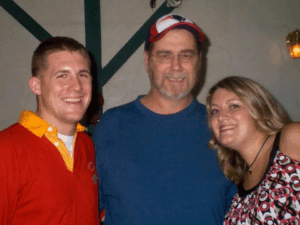
My sister Kaitlyn and I were both tested for PKD as teenagers and were cleared. We were lucky. However, my sister tested positive a couple of years after her son Zachary was born. This was devastating news for our family. I was retested around 2007, and my kidneys were clear: I did not have PKD. That was the moment I knew my duty—someday, Kaitlyn would need one of my kidneys.
Being active duty in the Marine Corps, I needed Kaitlyn to survive until my retirement date. As we got closer to my earliest possible retirement date, Kaitlyn’s kidney function—her glomerular filtration rate (GFR)—started to tank. I was 14 months away from possible retirement when her doctors made the call … it was time. From there, the testing and planning began.
I knew the testing would be lengthy and would require multiple trips to Boston. After two trips to Boston, countless vials of blood taken, probably a gallon or so of urine collected, a couple 24-hour blood pressure tests, review by the Brigham and Women’s donation board, and lots of prayers, I was approved to donate.
I received two calls that I will never forget. I received the first call in May, saying I was conditionally approved pending blood pressure meds and a second 24-hour blood pressure reading six weeks later. I did what anyone would do, I closed my door and had a moment, then called Kaitlyn. We were not in the clear yet—I had to score better on the blood pressure test the second time around and I needed Department of the Navy approval. But I was conditionally approved.

That six weeks of waiting to retest was truly stressful. I cried at times and pretended everything was perfectly fine. Very few people knew how close I was to being disqualified. Passing a second blood pressure test with all that stress seemed impossible. My saving grace were frequent tests from local corpsmen that showed I was improving.
I took the test and got the second call a week later. I was standing on the bow of a pontoon boat with the kids swimming in the Ozarks. I was happy to be able to celebrate that moment with Kaitlyn, the kiddos, and close friends. Now it was time for the final submittal to the Department of the Navy for their approval.
Luckily, there was still a way for me to donate in service. It took a lot of calls, emails, policy reading, and discussions. I needed approval from the Marine Corps and the Navy’s Bureau of Medicine and Surgery (BUMED). Surprisingly, it only took a few medical appointments and lots of paperwork to request consideration. BUMED requires ~60 days, the donations Chief said in an emergency they could process it in about three weeks. I submitted on a Wednesday and was approved on the following Tuesday, with a four-day weekend in-between. The Navy Chief let me know he was 31 for 31 with getting in-service donations approved.
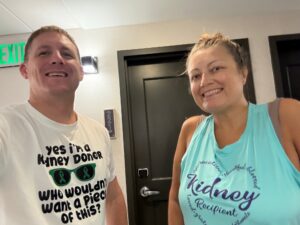
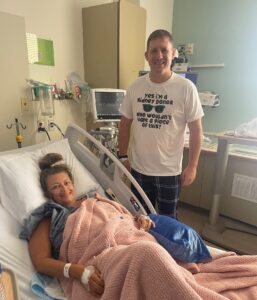
On the day of our surgeries, July 29, Kaitlyn and I checked into Brigham and Women’s at 5:30 a.m. Kaitlyn went into surgery at 8:48 a.m. and I went in at 10:10 a.m. Due to complications with the size of Kaitlyn’s kidneys, they had to change the surgery plan.
I was in recovery by 2:30 p.m. and all went well with the kidney removal. Kaitlyn’s left kidney was removed to make room for my kidney, and the doctor also performed a hernia repair. Kaitlyn was in recovery by 5 p.m.
I took my first steps the night of surgery and was able to visit Kaitlyn. I was out of the hospital within three days and walked my first mile on day six… I was back to running by 26 days after the surgery.
Matthew Kelly
Everything that was accomplished on that day was nothing short of a miracle. Hearing the words on the evening of July 29 that the surgery was a success and Kaitlyn was already peeing was the best news we could have received.
Kaitlyn took a beating with three surgeries in one. She took her first steps on day four and is now on a long road to recovery. Most importantly, by week two, her GFR was in the 60s and her creatinine was below 1.2.
I took my first steps the night of surgery and was able to visit Kaitlyn. I was out of the hospital within three days and walked my first mile on day six. I stayed in a hotel for about 10 days before flying home to Louisiana. I was back to running by 26 days after the surgery.
From my first test at Quest Diagnostics on February 13 in Mandeville, Louisiana, to the pre-op blood tests on July 14 in Boston, the five-month journey was long and stressful. The donation itself seemed like the easy part. Three weeks of recovery from surgery seems like nothing compared to Kaitlyn’s years of suffering.
There are so many people we need to thank, and we apologize if we forget to mention anyone. Our mom, who is going through this journey with all of us; family, friends, and anonymous people who donated, called, texted, and supported us through the process; Marine Corps and BUMED personnel who helped with the testing, screening, and approval process; medical providers that conducted testing and explained everything; the Brigham donation board, which gave me a waiver and approval to donate; all the people who started the testing to try and donate a kidney; and those following and supporting the journey.
About the Author
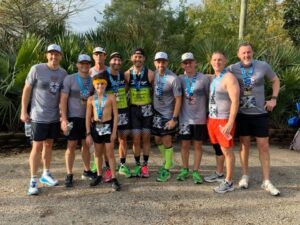
Matt grew up in Carver, Massachusetts, and moved to Providence, Rhode Island, after graduating high school. Matt was an active wrestler and was the captain of both his high school and college teams. After receiving a bachelor’s degree in political science in 2006 from Rhode Island College, he commissioned as a Second Lieutenant in the United States Marine Corps. He continues to serve the Marine Corps on active duty as a Lieutenant Colonel and is stationed in New Orleans with his mother and three children. During his career, he deployed multiple times and earned two graduate degrees. Matt is active in his community with coaching and running. He is 15 states into his quest to run a marathon in all 50 states. Matt is actively running post-surgery and is planning his next marathon.